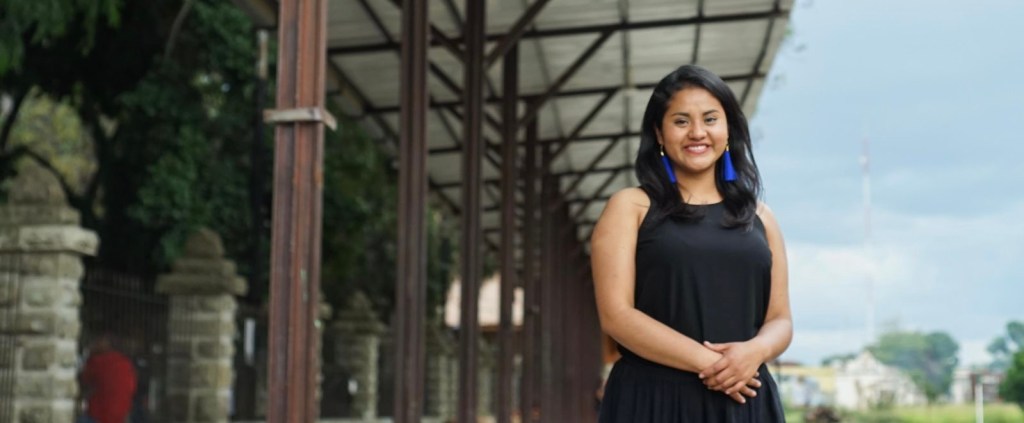
Nadia López García, also known as Nadia Ñuu Savi, is a poet and writer in the Mixtec language. She lent her voice to the character of Sofia in the film Itu Ninu. In this conversation, we discuss writing in Mixtec and her involvement in the movie Itu Ninu.
When did you become interested in writing in Mixtec?
I grew up in the northern border of the country, surrounded by strawberry, tomato, and cucumber fields. My parents worked as farm laborers for many years. I was 8 years old when they decided to return to Oaxaca, leaving behind that dusty, desert-like place where the largest agricultural fields in our country are located. It was then that I entered a nasal, tonal, and glottal world, although I didn’t know at the time that Mixtec had these characteristics. I began speaking the language of my mother’s family, and I was fascinated by it. My first formal attempts at writing started at the age of 17, although initially, my approach was quite orally focused. I used spellings that didn’t exist in the Mixtec alphabet. In my early poems, I wrote everything phonetically, as I heard it. Over time, I gained more knowledge, searched for vocabulary, and learned that I should mark the tones when writing Mixtec. I’m still exploring how to write in Mixtec. The writing standard for Mixtec was just recently published.
What inspires you?
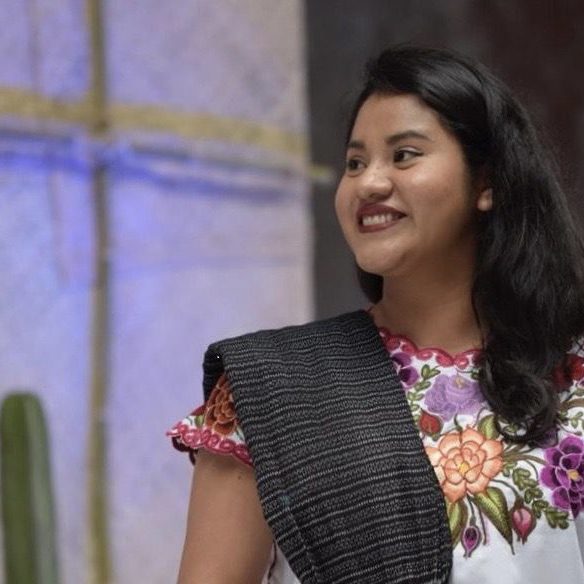
I belong to a family that started migrating when I was very young. I had the opportunity to study at the university, which is very unique among the women in my family. For many generations, women didn’t go to school. The desire to study has allowed me to live in various places in Mexico and also abroad. I write a lot about migration, about nostalgia, about being far from home and leaving behind your surroundings and family. Migration is a constant in the Mixtec community, and that motivates me to tell these stories that are often absent in Mexican literature. Additionally, I focus on the experiences of Mixtec women who have faced resistance to silence in a complex context.
What challenges do you face when writing in Mixtec?
One of the biggest challenges is the lack of literacy in our native language. The education system lacks support for teaching Indigenous languages. Often, teachers who speak an indigenous language cannot provide pedagogical support in their own language because they are assigned to teach in another community with a different language. In my case, I studied in a Mixtec community where there were no Mixtec teachers, and one of the few teachers had the mindset that we should learn about the world and its realities in Spanish.
Another challenge is how to socialize and transcend writing in our language. We should not limit ourselves to publishing books; we must share the language. Many times, those of us who write think our work ends when the book is printed, but I believe it actually begins then. Something I have embraced a lot is the idea that, more than writing, we should conduct workshops. Writing should be connected to dialogue and the socialization of the language.
Another complication is that government support for those creating in Indigenous languages is still very scarce. For example, the writing grants offered by FONCA in the Indigenous languages category range from 5 to 7 grants. These grants include scriptwriting, narrative, and poetry. In other words, they consider all Mexican Indigenous languages as one single category. But in Spanish, for example, there are 7 grants just for poetry, 7 other grants for narrative, and so on. So, there are actually very few opportunities for Indigenous writers.
It’s also important for writers in Indigenous languages to find and support each other. I think sometimes we need to find each other and connect. Poetry offers an opportunity to resist capitalism through our language.


What does preserving and promoting the Mixtec language and culture through writing mean to you?
Promoting our language and culture is a way to challenge the idea that indigenous languages are synonymous with backwardness. Our languages have their own poetics and potential. By writing and sharing my language and culture, I want to show that Ñuu Savi (Mixtec culture) also has much to offer. We need to change the narrative that made us believe our languages were less valuable and that being monolingual was the best. Furthermore, our languages are rapidly disappearing, and it is crucial to keep them alive.
What role does oral tradition play in your writing, and how do you incorporate it into your works?
My writing is nourished by what I hear, see, and experience in my community. I incorporate collective practices, such as those to heal from sadness, which are part of our traditions. Orality is fundamental; we must engage in dialogue and make our words resonate. Many of my poetry books are accompanied by audio material so that people can listen to the language. Orality is essential to me.
What are your thoughts on the recognition and promotion of indigenous languages in Mexico and the world?
Our country still has a lot of work to do in terms of supporting creators in indigenous languages. There should be more grants and support for languages like Mixtec, Zapotec, and Nahuatl. On a global scale, capitalism and modernity have often viewed Indigenous peoples as backward, which is a misguided perspective.
How did you become involved in the project Itu Ninu?
I got involved thanks to an invitation from filmmakers Armando Bautista García and Itandehui Jansen, an opportunity I didn’t expect. It was a significant challenge because I had no prior experience in this. I tried to do my best, not only in translation but also in the voice-over. It was a beautiful, enriching experience, and I hope there are more projects like this where our voices continue to be heard.
What are your thoughts on this Mixtec story being set in an urban setting in the future?
It’s beautiful and logical, as Mixtec migration often leads us to unexpected places. The futuristic plot reminds us that we are not far from a future where communication through our languages will become increasingly difficult. The film also highlights the importance of preserving our identities and languages in urban and challenging environments. This film excites me because of the migration theme, but there’s also a beautiful metaphor about preserving and nurturing seeds in a future where there is no habitable land, where things no longer germinate. These two people are preserving their languages, they can communicate, and they can make the possibility of life and communication sprout as a rebellious and alternative response to the desolate environment surrounding them. In reality, the seeds represent our language, our identities, which are the only things that can sustain us. I think of my own experience of living in different places. By knowing who you are, maintaining your language, and holding onto your identity, you can navigate chaos. Many years ago, I was in India, in New Delhi, at the market. It was utter chaos, with what felt like seven different languages being spoken. At that moment, I started thinking in Mixtec, and I stopped feeling stressed. I felt that internally, I was in my place. This is the metaphor, that language and identity can make you belong to a certain space. Maintaining our languages even in the most urban and desolate spaces is a matter of resistance.
What do you think of the character of Sofia?
The character of Sofia represents the courage to not fear the other. I found it beautiful to think that this couple begins to connect through their original language and then builds bonds of support. Their journey from initial distrust to building connections based on tenderness is inspiring. Sofia embraces the reality of the community and understands that individuality is not enough to survive.
What advice would you give to young indigenous women who want to follow in your footsteps in writing in their native language?
Firstly, challenge the idea that being born a woman is a disadvantage. For many years, we were made to believe that being born a woman meant being born with a disadvantage. Even today in my community, when a girl is born, it’s seen as a synonym for loss, as it means she will go to another house to serve. So, it’s necessary to shake off that idea and resist it. Of course, there will be obstacles, criticism, and people who don’t like what we do. But we need to keep going.
Secondly, be disciplined. As women, inhabiting female bodies in this world, we face more complexities. Many of us who create have all the responsibilities of caring for our families, cleaning, and supporting a household. We also work, teach, and have many other obligations, so finding time for ourselves to write, read, and create isn’t always easy. Therefore, I would say, be disciplined with what you want to do. There could be a thousand things to attend to, but if I set a goal to read for an hour every day, then I will read for an hour every day.
It’s also important to surround ourselves with people with whom we can collaborate, who will support and sustain us. In my case, my partner is crucial support.

Are you working on any new projects?
I am working on several projects, all related to my language and my community. Among them is the publication of a book about women’s bodies, which has always been a body that… it almost seems like it doesn’t belong to us, because of all the secrecy surrounding it. It deals with desire, it deals with the kind of love we were told about. It’s a book that reflects a bit on my process of rethinking myself, of rediscovering myself from the perspective of this female body I inhabit… from getting married at a very young age, from seeing how some of the women in my family who didn’t marry are viewed very negatively, as unmarried, childless… so, it speaks a bit about the body of a woman in a Mixtec context. I’m also working a lot on workshops. Right now, next week, I’m starting a digital activism workshop in indigenous languages. After that, there’s another workshop on new narratives related to writing, which includes scriptwriting and is aimed at people from indigenous communities. I teach, I study. For many years, I have collaborated with Jorge Valderrama, who is a musician and composer, and we have worked on several sound ideas that involve Mixtec. We have a project, and hopefully, it will come out soon. I’m happy and grateful for these opportunities.
 Itu Ninu
Leave a comment